Productivity App Marketing: Video Ads That Show Time Saved
A productivity app sells time back, and its ad can show it: a task done in the app in a few seconds. Saying it is harder. Every ad network asks for proof of a claim that the app saves 10 hours a week. These are the networks', the stores' and the FTC's own pages, read on 31 October 2026.123
 Productivity app ads
In short
- Show, then say: the task done on screen beats a number you cannot prove. Google found ads where the app is the ad did 10% better on installs.4
- Proof first: the FTC says "advertisers have proof before the ad runs". TikTok bars "absolute terms about a product in relation to time".13
- The first seconds: TikTok says catch attention "in under two seconds".5
- Sound off: "Since videos autoplay without sound, captions help ensure your message is clear from the first frame".6
- What apps report: Smart Printer App & Scan reports 251% download growth on Apple Ads; iTranslate, 7M+ downloads in three years.78
What counts as a productivity app?
Apple's words: "Apps that make a specific process or task more organized or efficient." Its examples run from task and calendar management to note taking, email clients and password management.9 PDF and scanning apps sit in Business on Apple.9
Google Play's Productivity examples: "Notepad, to-do list, keyboard, printing, calendar, backup, calculator, conversion".10 Email management sits in Business there, so pick the category for each store.10
Can a productivity ad claim time saved?
Only with proof. The rules are close on every network:
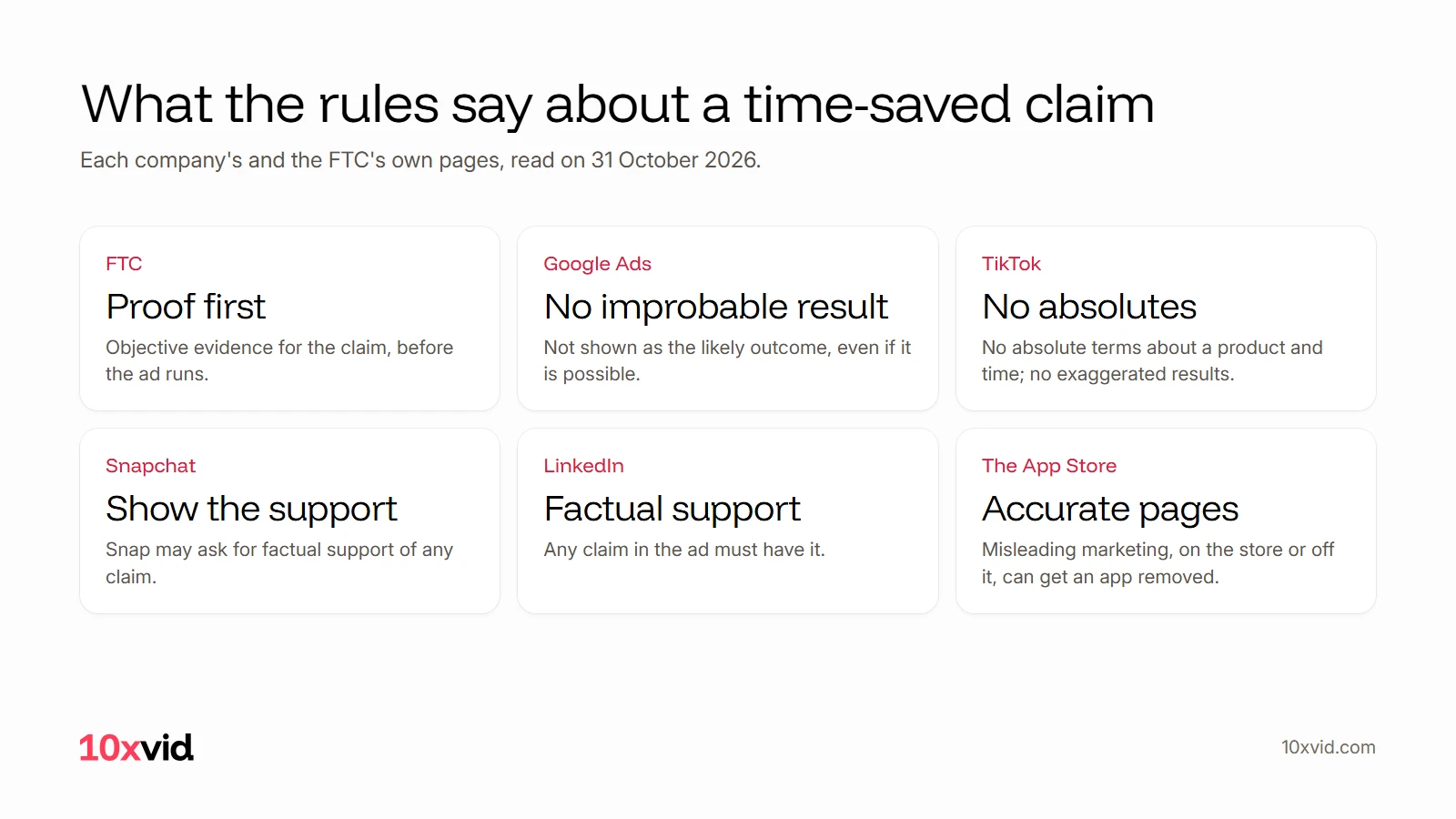
- FTC: "The law requires that advertisers have proof before the ad runs." That means a "reasonable basis", which is "objective evidence that supports the claim".1
- Google Ads: no "claims that entice the user with an improbable result (even if this result is possible) as the likely outcome a user can expect".2
- TikTok: ads "must not promise or exaggerate results concerning a product's effect", nor use "absolute terms about a product in relation to time, region, or brand".3
- Snapchat: Snap may "require factual substantiation for any claim made in an ad".11
- LinkedIn: "Any claims in your ad must have factual support."12
- Apple: misleading marketing "whether within or outside of the App Store, is grounds for removal of your app".13
A customer's result in the ad is read as what others can expect. The FTC: "Statements like “Results not typical” or “Individual results may vary” won’t change that interpretation."14
How do you show time saved without a claim?
Let the screen do it. A viewer who sees five steps become one counts the time for themselves:
- The task, start to finish: Google's advice for video is "Show how it works", then "Make the product the ad" and "Be exact and tangible".15
- A number you measured: Meta suggests showing "the number of minutes a particular utility app can save you per day".16 Keep the measurement that number came from.
- A real-looking screen: Apple asks store screenshots to "display fictional account information instead of data from a real person". The same habit keeps a demo safe in an ad.13
- One task an ad: a scanner ad scans, a calendar ad books. Smart Printer App & Scan made pages by intent, such as a tax-season page: "Print your forms with a tap."7
What should a productivity app video ad show?
The app working, early, with words on screen:
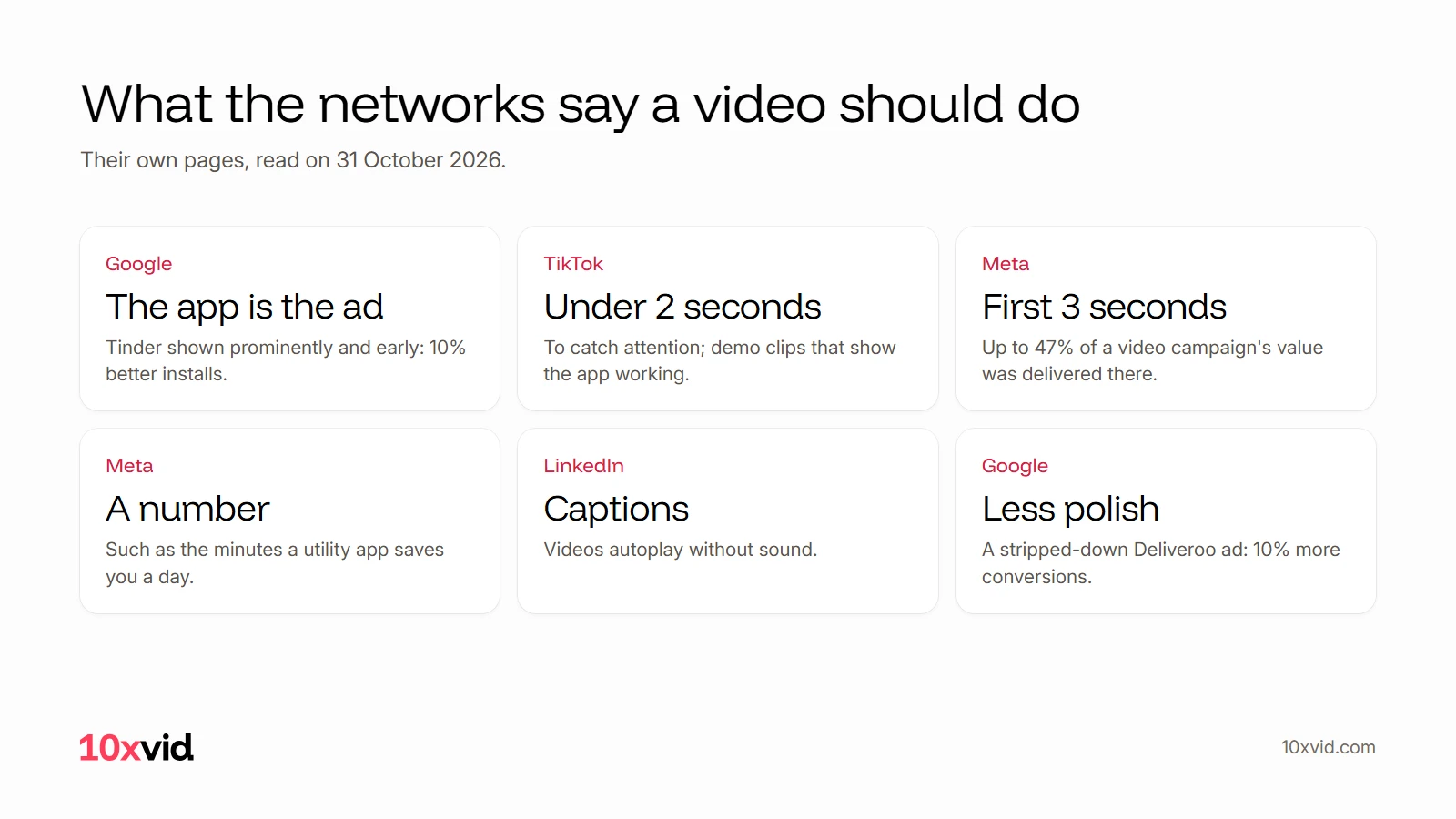
- The app as the ad: "When Tinder did this, essentially making the app the ad, its install performance improved by 10%."4
- Fast: "Capture attention in under two seconds." TikTok also suggests "Short gameplay or demo clips that show app functionality".5 An older Meta page found "up to 47% of the value in a video campaign was delivered in the first three seconds".17
- Words on screen: "Since most video ads in mobile feed are viewed without sound, make sure to express your message visually", from an older Meta page.17 On Reels, "Reels default to Sound On."18
- Plain over polished: a stripped-down Deliveroo ad "performed 10% better in terms of conversions" than the polished one.4
- Length: LinkedIn suggests "15-30 seconds for top-of-funnel awareness campaigns".19
For the first line, see video ad hooks.
What have productivity apps reported from ads?
Most published results come from Apple Ads and LinkedIn. We found none from a productivity app on Meta's or TikTok's story pages:
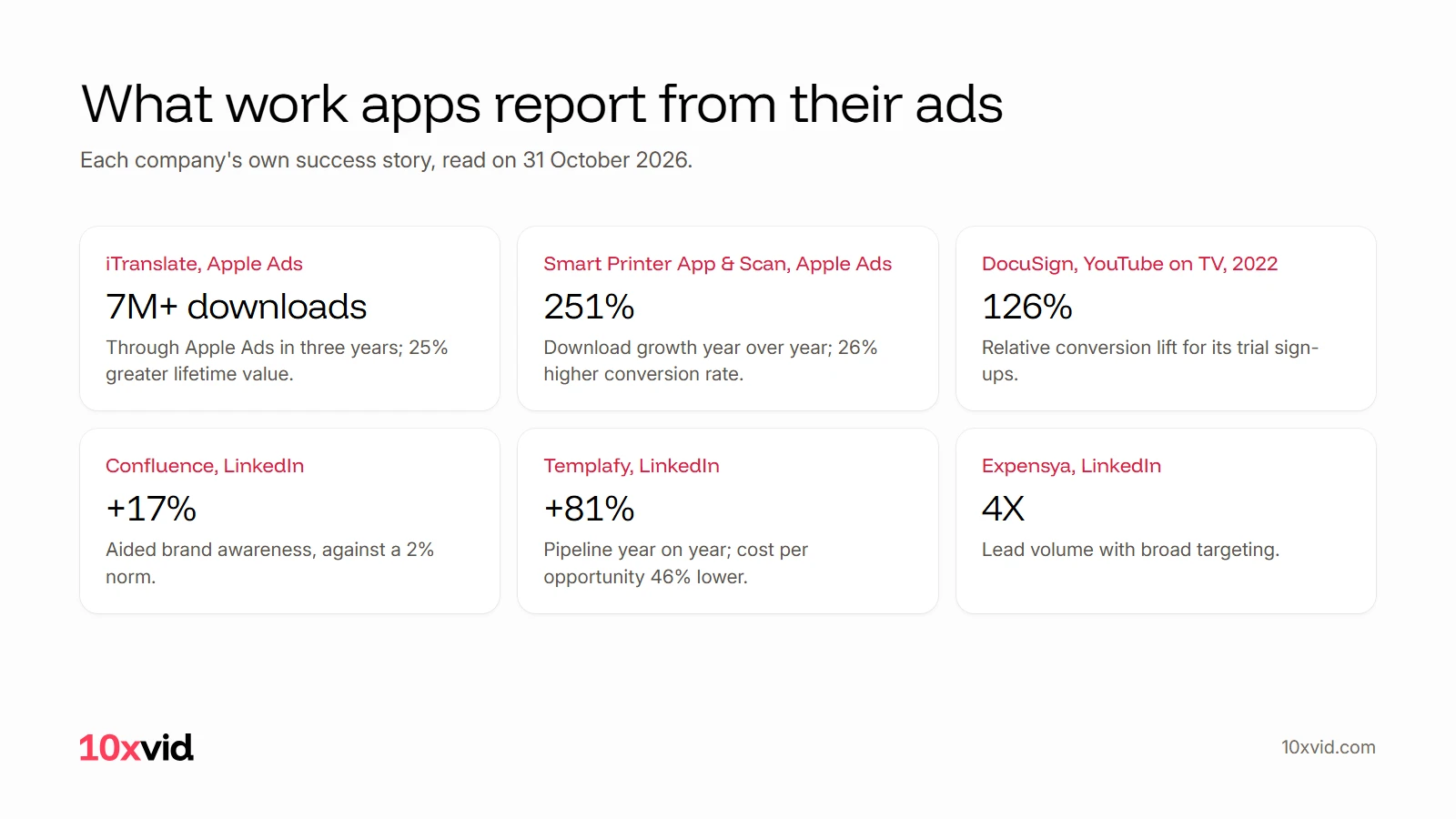
- iTranslate, Apple Ads: "7M+" downloads "through Apple Ads in three years", and 25% greater lifetime value than other paid channels.8
- Smart Printer App & Scan, Apple Ads: 251% download growth and a 26% higher conversion rate, year over year.7
- DocuSign, YouTube on TV: "a 126% relative conversion lift for its trial sign-ups".20
- Confluence, LinkedIn: a 17% lift in aided brand awareness, "vs. a 2% norm", with a brand video and creative for each role.21
- Templafy and Expensya, LinkedIn: 81% pipeline growth year on year, and four times the lead volume.2223
The Apple Ads results are search ads, not video. They show where productivity apps are found: in search, by people with a task.78
What do the stores allow on a productivity app's page?
The ad leads to a store page with its own rules:
- Apple subtitles: they "should not include inappropriate content, reference other apps, or make unverifiable product claims."13
- Apple previews: "previews may only use video screen captures of the app itself."13
- Google Play: "We also don't allow unattributed or anonymous user testimonials in the app's description."24
- Google Play rankings: no "Images or text that indicate store performance or ranking, such as 'App of the year,' '#1,'" in the title, icon or developer name.24
Where 10xvid fits
10xvid, motion graphics ads for apps, makes the video from your link, on your app's real screens. It runs 5 to 30 seconds, in 9:16, 1:1 and 16:9.25 Say in the chat which task the ad should show. It does not check a time-saved claim for you; keep the proof.
Solo is about 30 video ads a month for $79, with the first month 50% off.26 Paste your link and make your first ad. For software sold on the web, see SaaS video ads.
Questions about productivity app ads
Can my ad say the app saves hours a week?
Only with proof in hand before the ad runs, by the FTC's rule. TikTok also bars absolute terms about time.13
Can I use a customer's quote about time saved?
Only if the result is typical, or the ad says what people can generally expect. "Individual results may vary" does not cover it.14
How long should a productivity app video ad be?
15 to 30 seconds is LinkedIn's advice for awareness. Catch attention in the first two seconds.195
Should a productivity app ad have sound?
Make it work without. LinkedIn and Meta say feed videos often play muted; Reels start with sound on.61718
- FTC, "Advertising FAQ's: A Guide for Small Business" (ftc.gov/business-guidance/resources/advertising-faqs-guide-small-business). ftc.gov refused our reader on 31 October 2026, so it was read in the Internet Archive's copy of 21 October 2026. ↩
- Google Ads policy, misrepresentation (support.google.com/adspolicy/answer/6020955), read on 31 October 2026. ↩
- TikTok ads policy, misleading and false content (ads.tiktok.com/help/article/tiktok-ads-policy-misleading-and-false-content), last updated April 2026, read on 31 October 2026. ↩
- Think with Google, "Creative rules for app campaigns" (business.google.com/en-all/think/future-of-marketing/creative-rules-app-campaigns), May 2022, read on 31 October 2026. ↩
- TikTok for Business, mobile app advertising guide (ads.tiktok.com/business/en/guides/mobile-app-advertising-guide), read on 31 October 2026. ↩
- LinkedIn Marketing Solutions, video ads (business.linkedin.com/advertise/ads/sponsored-content/video-ads), read on 31 October 2026. ↩
- Apple Ads, Smart Printer App & Scan success story (ads.apple.com/app-store/success-stories/smart-printer-app-scan), undated, read on 31 October 2026. ↩
- Apple Ads, iTranslate success story (ads.apple.com/app-store/success-stories/itranslate), undated, read on 31 October 2026. ↩
- Apple Developer, App Store categories (developer.apple.com/app-store/categories), read on 31 October 2026. ↩
- Play Console Help, categories and tags (support.google.com/googleplay/android-developer/answer/9859673), read on 31 October 2026. ↩
- Snap, advertising policies (snap.com/ad-policies), read on 31 October 2026. ↩
- LinkedIn, advertising policies (linkedin.com/legal/ads-policy), last revised 18 November 2025, read on 31 October 2026. ↩
- Apple, "App Review Guidelines" (developer.apple.com/app-store/review/guidelines), last updated 16 October 2026, guideline 2.3, read on 31 October 2026. ↩
- FTC, "FTC's Endorsement Guides: What People Are Asking" (ftc.gov/business-guidance/resources/ftcs-endorsement-guides-what-people-are-asking), read in the Internet Archive's copy of 27 October 2026. ↩
- Google Ads Help, the ABCDs of effective video ads (support.google.com/google-ads/answer/14783551), read on 31 October 2026. ↩
- Meta Business Help Center, accelerating app growth (facebook.com/business/help/1571320809813662), read on 31 October 2026. ↩
- Meta for Business, "Updated features for video ads" (facebook.com/business/news/updated-features-for-video-ads), undated, citing 2015 data, read on 31 October 2026. ↩
- Meta for Business, Reels ads (facebook.com/business/ads/facebook-instagram-reels-ads), read on 31 October 2026. ↩
- LinkedIn Marketing Blog, "13 top tips for compelling B2B video content on LinkedIn" (linkedin.com/business/marketing/blog/content-marketing/13-top-tips-for-compelling-b2b-video-content-on-linkedin), 5 June 2025, read on 31 October 2026. ↩
- Think with Google, YouTube on connected TV (business.google.com/us/think/search-and-video/youtube-ctv-advertising), October 2022, read on 31 October 2026. ↩
- LinkedIn, Atlassian customer story (business.linkedin.com/advertise/customer-stories/atlassian-ctv), undated, read on 31 October 2026. ↩
- LinkedIn, Templafy customer story (business.linkedin.com/advertise/customer-stories/templafy), undated, read on 31 October 2026. ↩
- LinkedIn, Expensya customer story (business.linkedin.com/advertise/customer-stories/expensya), undated, read on 31 October 2026. ↩
- Play Console Help, metadata policy (support.google.com/googleplay/android-developer/answer/9898842), read on 31 October 2026. ↩
- 10xvid.com/engine, read on 31 October 2026. ↩
- 10xvid.com/pricing, read on 31 October 2026. ↩