Wellness App Marketing: Video Ads Within Health Ad Rules
A wellness app can run video ads on every big network. The ad must not tell viewers what they suffer from, promise a cure, or reach for their health data. Meta's own example: "Depression counseling" is allowed, and "Depression getting you down? Get help now." is not. That is each company's own policy pages, read on 27 October 2026.12
 Wellness app ads
In short
- The big rule: describe the app, not the viewer. Meta bans ads that assert or imply a person's "physical or mental health (including medical conditions)".1
- Claims: no cures. Google bans "unproven claims of cures for incurable medical ailments", and TikTok "Claims of cures for incurable diseases".34
- Targeting: on Google, health is a sensitive category, and "You can't use advertiser-curated audiences."5
- Data: Meta may restrict the events a "wellness tracker" sends it.67
- The app itself: Apple reviews medical apps "with greater scrutiny".8
This page is a map of the companies' own rules, not legal advice. Fitness apps have rules of their own on bodies and weight loss: see fitness app ads.
What rules apply to wellness app ads?
Every network has a health policy, and they share a shape:
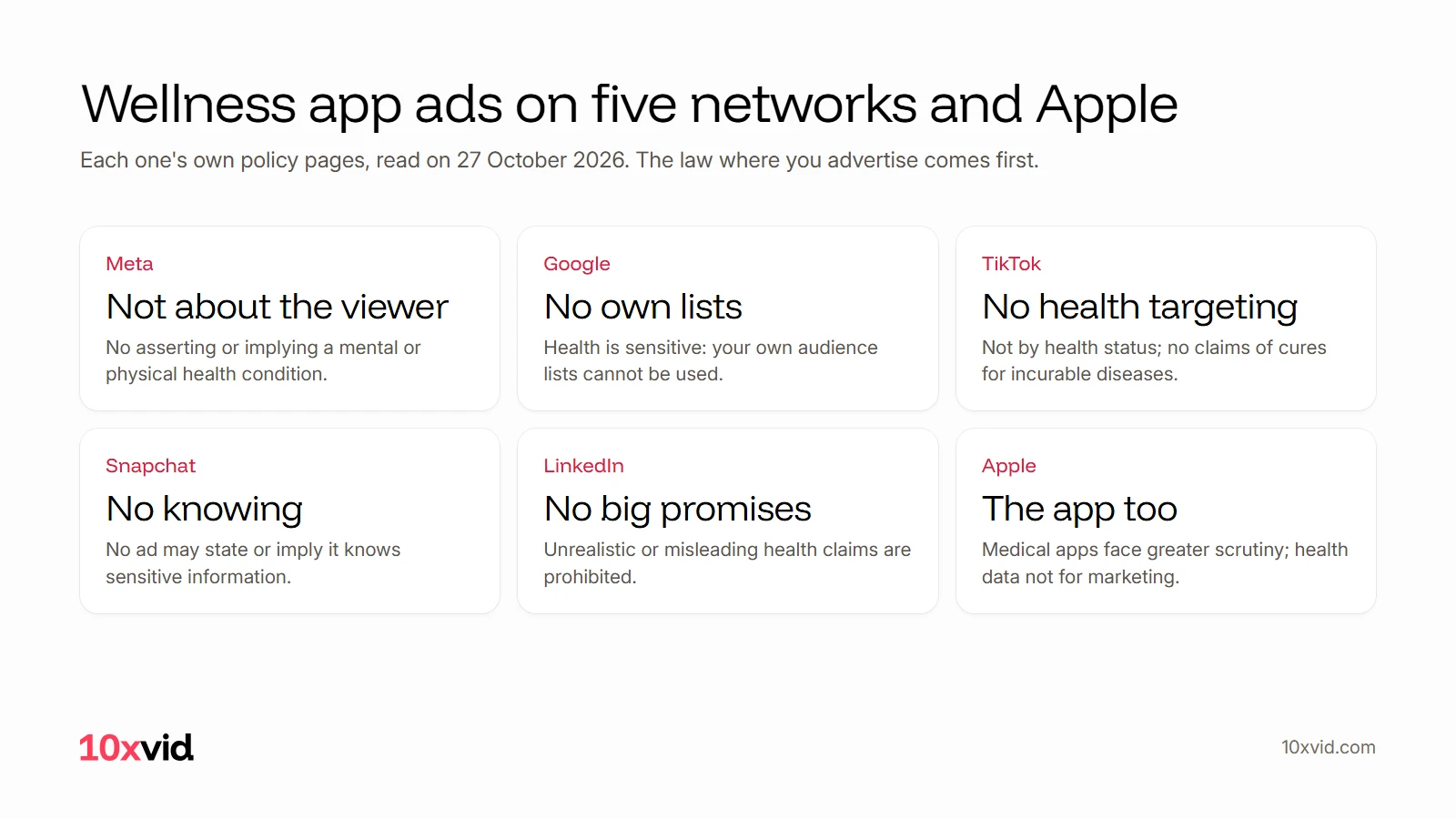
- Meta: "ads must not contain content that asserts or implies personal attributes", health among them.1
- Google: health is a sensitive category for personalized ads, and nobody under 18 gets personalized ads.5
- TikTok: no targeting on "Individual health statuses or disabilities, including mental, physical, genetic, or emotional health and conditions."9
- Snapchat: "Ads must not state or imply knowledge of personal data, sensitive information, online activity, or the precise whereabouts of a user."10
- LinkedIn: "Ads promoting unrealistic or misleading claims about health improvements, including those related to diet and weight loss, are prohibited."11
How can a wellness ad talk about mental health?
By naming the service, not the viewer's state. The companies give their own examples:
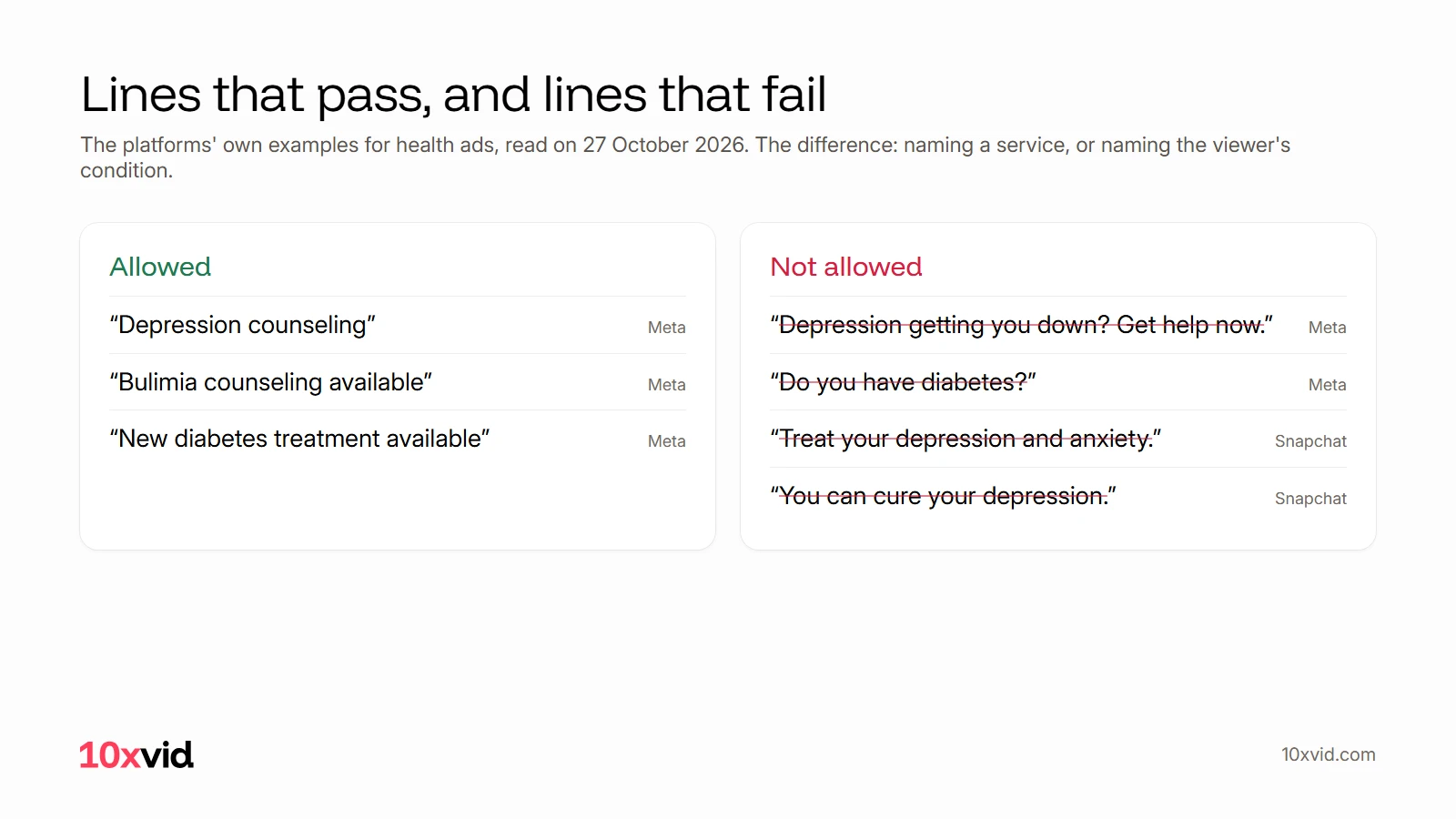
Meta's Business Help gives one more. "If you are tired of dealing with depression, call us for free therapy sessions." fails, because it "contains statements that assume the audience suffers from depression, and uses the word “you”." Meta's fix: "Provide information on your product or service and the unique benefits it provides."12
"You" is not banned. Meta allows "“you/your” language without a personal attribute."1 TikTok's health guide suggests "soft phrasing like "supports" or "helps maintain"".13
Which wellness claims are banned?
Cures, timed promises and fear:
- Cures: Google bans "unproven claims of cures for incurable medical ailments"; TikTok, "Claims of cures for incurable diseases".34
- Timed promises: Meta bans "promises of specific outcomes within a set timeframe without disclaimers or qualifiers".2
- Results: Google: "Testimonials that claim specific results must include a visible disclaimer".3
- Fear: Google bans ads that use "negative life events such as death, accidents, illness, arrests or bankruptcy" to pressure the viewer.14
- Snapchat's examples of lines that fail: "Remove your stress and joint pain." and "This product will eliminate brain fog."10
TikTok sums up where its feed fits: "TikTok is best for educational and lifestyle messaging, not clinical promotion."13
Who can a wellness ad reach?
Fewer people, chosen by the network more than by you:
- Meta, age: health products go to people 18 and older, but "Products and services marketed for general wellbeing, such as fitness services and equipments, health clubs" are exempt.2
- Meta, cycle apps: an "Ovulation tracker" is on its 18+ list; "menstruation tracking health apps" are exempt.2
- Google: with health a sensitive category, "You can't use advertiser-curated audiences", and "Users under the age of 18 are not eligible for personalized advertising of any kind".5
- TikTok: no targeting by health status at all.9
- Apple Ads: "Ad content for pharmaceutical products, medical devices, and medical services may be shown to adults only."15
What happens to a wellness app's data on Meta?
It may be measured less. Meta's "Health and wellness" category covers apps tied to health, with "a patient portal, wellness tracker, telemedicine platform" among its examples.6 A restricted category can mean that Meta "Restricts the sharing of specific mid and lower funnel events."7 And among what you may not send at all: "Mental health and psychological states".16
Fewer events back can mean the network learns less about who installs. The ad then does more of the finding: it says plainly who the app is for, through what it does.
What about therapy and telehealth apps?
They have their own rules:
- Meta: you may "Promote telehealth services generally" without written permission.17 To prescribe, "Meta requires telehealth providers to be actively certified with LegitScript before submitting an application."18
- Google: "Google allows telemedicine providers if they’re accredited by LegitScript", in the US and Canada.19
- Meta lead ads: they "must not request health information, including physical health, mental health, medical treatments, medical conditions or disabilities without our prior permission."20
What do Apple's rules add?
Rules for the app, which the ad has to match:
- Medical apps: "Medical apps that could provide inaccurate data or information, or that could be used for diagnosing or treating patients may be reviewed with greater scrutiny." And "Apps should remind users to check with a doctor in addition to using the app and before making medical decisions."8
- Health data: HealthKit data "may not be used for marketing, advertising or use-based data mining, including by third parties".8
- New for 2027: health and medical apps in the EEA, the UK and the US must say whether they are a regulated medical device. "Existing apps distributed in these regions that meet either of the criteria above must provide a status by early 2027."21
How do you make a wellness ad that passes review?
Six checks before it runs:
- Name what the app does, not what the viewer has, as in the companies' examples above.
- Soften the verb: supports, helps, guides. Never cures, treats or eliminates.
- No deadline on a result without a qualifier.
- Show the real app, its screens and its sessions, so the ad promises what the app gives.
- Set the age where the network asks for 18 and older.
- Keep the lead form free of health questions unless the network has given permission.
Here is a wellbeing app's ad. Its first line is about a kind of content, not about the viewer:
Where 10xvid fits
10xvid, motion graphics ads for apps, draws every frame from your real screens, your type and your pictures. The ad shows what the app is.22 Paste your App Store link or website into the chat. The blueprint shows every part of the ad before it is made, and you can change any line.22
10xvid does not check an ad against these rules. Read every line, against the network's own examples above. The first ad is free, with no card: make your first ad.
Questions about wellness app ads
Can a meditation app advertise on Facebook?
Yes. Meta exempts general wellbeing from its 18+ health rule, but the ad must not assert or imply the viewer's mental health.21
Can my ad ask viewers about their health?
Not on Meta: its own example "Do you have diabetes?" is not allowed. Name what the app offers instead, as in its allowed "Depression counseling".1
Do wellness app ads need 18+ targeting?
It depends on the network and the product. Meta asks 18+ for health products but exempts general wellbeing; Apple Ads shows medical services to adults only.215
Can I target people by health condition?
No. TikTok bans targeting by health status, and Google bars your own audience lists for health ads.95
- Meta Transparency Center, "Privacy Violations and Personal Attributes" (transparency.meta.com/policies/ad-standards/objectionable-content/privacy-violations-personal-attributes), read on 27 October 2026. ↩
- Meta Transparency Center, "Health and Wellness" (transparency.meta.com/policies/ad-standards/restricted-goods-services/health-wellness), read on 27 October 2026. ↩
- Google Ads policy, unreliable claims (support.google.com/adspolicy/answer/15936857), read on 27 October 2026. ↩
- TikTok Ads policy, "Misleading and False Content" (ads.tiktok.com/help/article/tiktok-ads-policy-misleading-and-false-content), read on 27 October 2026. ↩
- Google Ads policy, personalized advertising: health (support.google.com/adspolicy/answer/16701855), read on 27 October 2026. ↩
- Meta Business Help Center, data source categories (facebook.com/business/help/1402913027039332), read on 27 October 2026. ↩
- Meta Business Help Center, data sharing restrictions (facebook.com/business/help/511197658391698), read on 27 October 2026. ↩
- Apple, "App Review Guidelines" (developer.apple.com/app-store/review/guidelines), last updated 16 October 2026, read on 27 October 2026. ↩
- TikTok Ads policy, anti-discrimination (ads.tiktok.com/help/article/tiktok-anti-discrimination-ad-policy), read on 27 October 2026. ↩
- Snap, "Advertising Policies" (snap.com/ad-policies), read on 27 October 2026. ↩
- LinkedIn, "Advertising Policies" (linkedin.com/legal/ads-policy), read on 27 October 2026. ↩
- Meta Business Help Center, personal attributes in ads (facebook.com/business/help/2557868957763449), read on 27 October 2026. ↩
- TikTok for Business, health and wellness advertising guide (ads.tiktok.com/business/en/guides/health-and-wellness-advertising), read on 27 October 2026. ↩
- Google Ads policy, clickbait ads (support.google.com/adspolicy/answer/15936667), read on 27 October 2026. ↩
- Apple Ads, "Ad policies" (ads.apple.com/policies), read on 27 October 2026. ↩
- Meta Business Help Center, prohibited information (facebook.com/business/help/361948878201809), read on 27 October 2026. ↩
- Meta Transparency Center, "Drugs and Pharmaceuticals" (transparency.meta.com/policies/ad-standards/restricted-goods-services/drugs-pharmaceuticals), read on 27 October 2026. ↩
- Meta Business Help Center, prescription drug and telehealth advertising (facebook.com/business/help/263390265553560), read on 27 October 2026. ↩
- Google Ads policy, "Healthcare and medicines" (support.google.com/adspolicy/answer/176031), read on 27 October 2026. ↩
- Meta Transparency Center, "Ad Standards" (transparency.meta.com/policies/ad-standards), read on 27 October 2026. ↩
- Apple Developer News, regulated medical device status (developer.apple.com/news/?id=nyqbfz1y), read on 27 October 2026. ↩
- 10xvid.com/engine, read on 27 October 2026. ↩