Education App Marketing: Video Ads Students Will Watch
An education app's video ad has two hard jobs. Many of its students are teens, and the networks narrow what they show teens and how ads find them. And it cannot promise a grade. So the ad itself has to find the student, and show the learning instead of a result. These are each network's own pages, read on 29 October 2026.123
 Education app ads
In short
- Teens: on Meta, "Age and location will be the only information about a teen that we’ll use to show them ads."4
- The EU: Meta's ads with EU, EEA or Swiss locations "can’t deliver to audiences under 18".1
- No promises: Google bans claims that "entice the user with an improbable result".2
- No cheating: essay generators, and even a picture of a student looking over a shoulder in an exam, are not allowed on Google.5
- Kids' apps: "Apps in the Kids Category should not include third-party analytics or third-party advertising."6
Who can an education app ad reach?
Fewer people, with less targeting, when they are under 18:
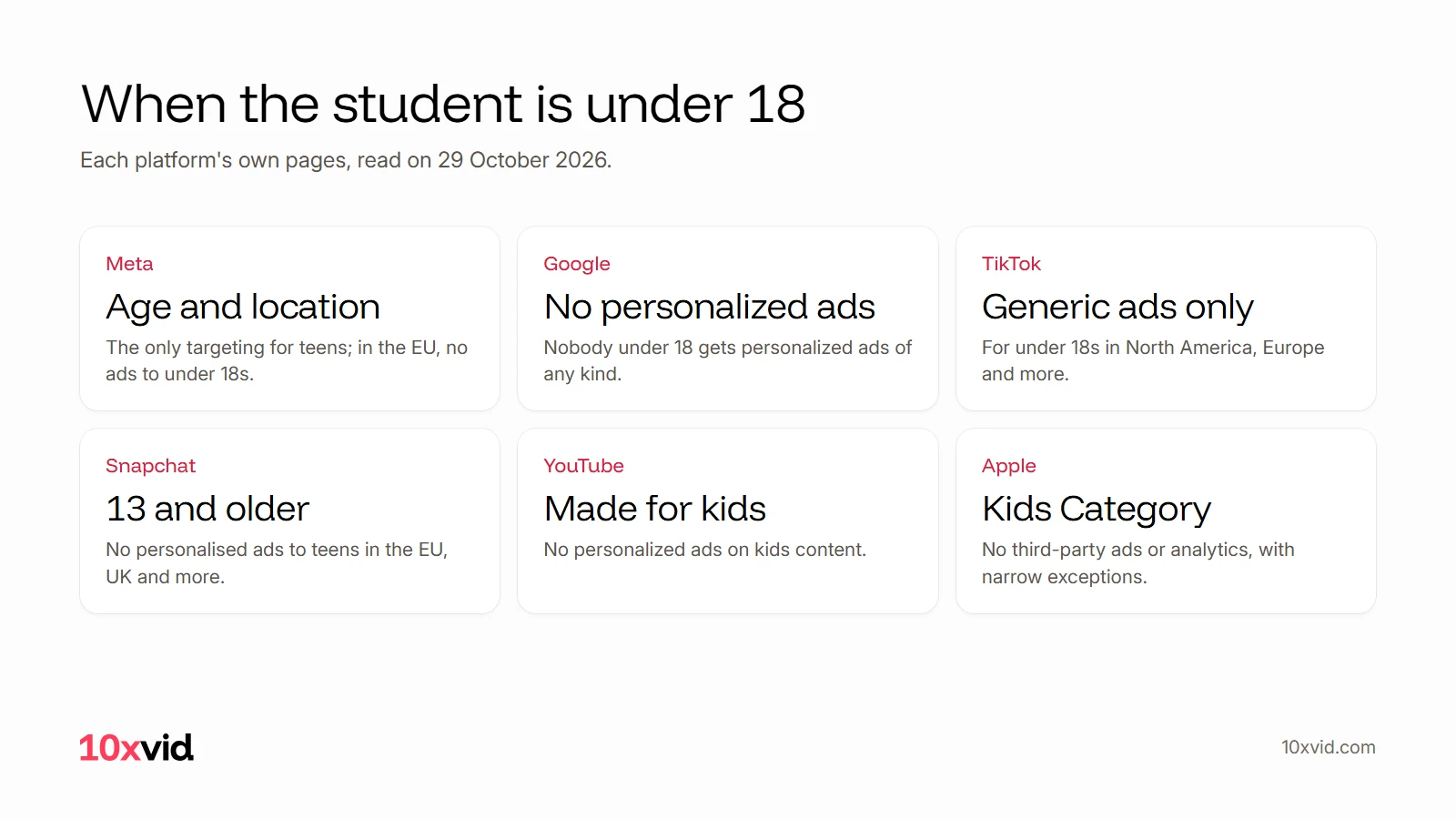
- Meta: "The minimum age on Facebook and Instagram is 13". For teens, interests, lookalikes and custom audiences are off, and "Advantage+ app campaigns can’t be used to reach teens."1
- Google: "Users under the age of 18 are not eligible for personalized advertising of any kind".7
- TikTok: in North America, Europe and other listed regions, "We ensure only generic ads are delivered to under 18 users".3
- Snapchat: "Snapchat is a 13+ app", and it does not serve teens in the EU, UK, Switzerland and Norway ads personalised on their interests.89
So the ad cannot lean on targeting. Its first line has to say who it is for: the exam, the subject, the grade.
What can an education ad promise?
What the app does, not what the student will score:
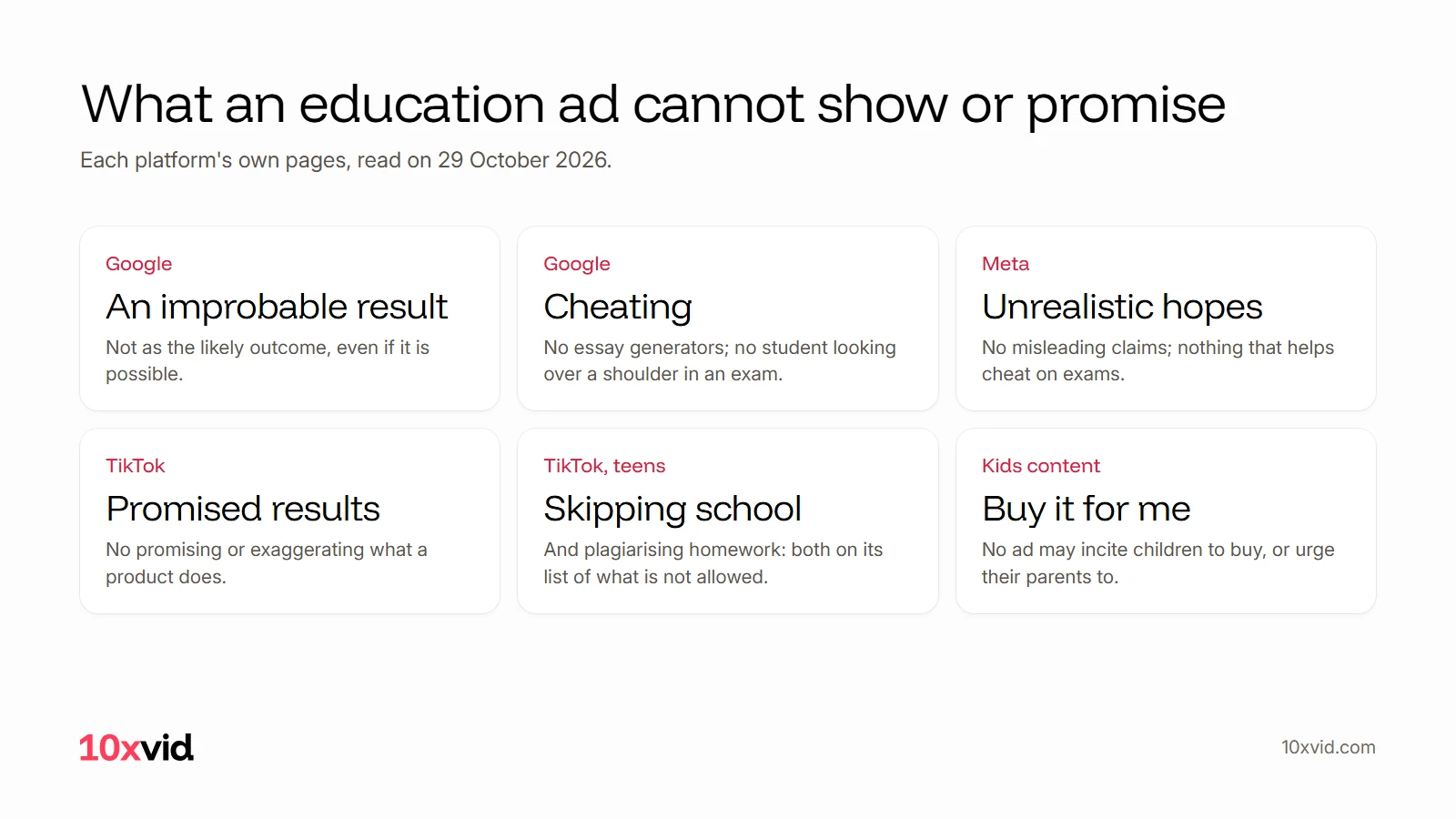
- Google: "Making inaccurate claims or claims that entice the user with an improbable result (even if this result is possible) as the likely outcome a user can expect is not allowed."2
- Google: "Services or products that enable academic dishonesty, like essay or thesis generators" are not allowed. Nor is an image "of a student looking over their shoulder during an exam while using your product".5
- Meta: ads must not "Make potentially misleading claims or set unrealistic expectations", or "Enable people to cheat on exams or drug tests".1011
- TikTok: "Ad content and landing pages must not promise or exaggerate results concerning a product's effect."12
- TikTok, for teens: "Skipping school" and "Plagiarising homework" are on its list of what is not allowed.13
We found no rule written only for education claims on these networks' pages. The general claim rules above are the ones that apply.
What changes if your app is for kids?
The parent becomes the audience, and the app has rules of its own:
- Apple: apps in the Kids Category should carry no third-party ads or analytics, with narrow exceptions.6
- Google Play: apps in its Families program use "only certified ad SDKs" and no personalized ads, and must not show an ad "immediately upon app launch".14
- YouTube: "we don’t serve personalized ads on kids content". On YouTube Kids, every paid ad is pre-approved by its policy team.1516
- Ads on kids content: "Paid ads must not incite children to purchase a product or urge parents or others to buy the item."17
- TikTok: in many markets, an ad for something that may appeal to children under 13 goes only to people 18 and older.13
What do students want to see in an ad?
Something they learn from, and someone like them who got there:
- TikTok: "77% of people on TikTok now want brands to create TikTok videos that teach them something new", from its 2021 study of 3,500 people.18
- Google, India: in a 2025 survey of adult learners, "real-world success stories of previous learners" was the message most likely to catch their attention.19
- TikTok's education guide: "Be specific about outcomes rather than making general claims about program quality."20
Specific and true, then. Show a real lesson in the app, and a real learner's result with its context, never a promise.
Do education apps grow with ads?
Some publish their results with the platforms. Reading Eggs, a reading app for children, reports a 52% "increase in trial sign-ups in the U.S." on Apple Ads, by Apple's own success story, which gives no date.21 Treat a case study as one app's story, not a forecast.
How do you make an education app ad that passes?
Six checks:
- Name the student in the first line: the exam, the subject or the year. See video ad hooks.
- Show a lesson in the app, on its real screens, in the first seconds.
- No score, grade or job promised. Show what the app does.
- No cheating in the picture: no copied answers, no glances in an exam.
- For kids' apps, speak to the parent, and never ask the child to ask.
- Set the age where the network asks for it. On Meta, ads in the EU, the EEA and Switzerland reach only people 18 and older.
Where 10xvid fits
10xvid, motion graphics ads for apps, draws every frame from your real screens, so the ad shows the lesson as it is in the app.22 Paste your App Store link or website into the chat. The ad comes in 9:16, 1:1 and 16:9, 5 to 30 seconds.22
10xvid does not check an ad against these rules: read every line before it runs. Paste your link and make your first ad.
Questions about education app marketing
Can I target students under 18 on Facebook and Instagram?
By age and location only, and not in the EU, the EEA or Switzerland, where Meta does not deliver ads to under 18s.14
Can my education app ad promise better grades?
No. Google bans improbable results as the likely outcome, and TikTok bans promising results.212
Can a kids' learning app run ads inside the app?
Apple's Kids Category asks for no third-party ads, with narrow exceptions; Google Play's Families program allows only certified ad SDKs.614
What should an education app ad show?
A real lesson in the app, and specific, true outcomes. In TikTok's own study, most of its users wanted brands to teach them something.1820
- Meta Business Help Center, "About advertising to teens" (facebook.com/business/help/229435355723442), read on 29 October 2026. ↩
- Google Ads policy, unreliable claims (support.google.com/adspolicy/answer/15936857), read on 29 October 2026. ↩
- TikTok Ads Manager help, advertising to people under 18 (ads.tiktok.com/help/article/about-advertising-to-people-under-the-age-of-18), read on 29 October 2026. ↩
- Meta Newsroom, age-appropriate ads for teens (about.fb.com/news/2023/01/age-appropriate-ads-for-teens), 10 January 2023, read on 29 October 2026. ↩
- Google Ads policy, enabling dishonest behavior (support.google.com/adspolicy/answer/6016086), read on 29 October 2026. ↩
- Apple, "App Review Guidelines" (developer.apple.com/app-store/review/guidelines), 1.3, last updated 16 October 2026, read on 29 October 2026. ↩
- Google Ads policy, personalized advertising (support.google.com/adspolicy/answer/143465), read on 29 October 2026. ↩
- Snap, "Advertising Policies" (snap.com/ad-policies), read on 29 October 2026. ↩
- Snapchat Business Help Center, regional considerations (businesshelp.snapchat.com/s/article/gdpr), read on 29 October 2026. ↩
- Meta Business Help Center, ad policy basics (facebook.com/business/help/757209948405699), read on 29 October 2026. ↩
- Meta Transparency Center, "Cheating and Deceitful Practices" (transparency.meta.com/policies/ad-standards/deceptive-content/cheating-and-deceitful-practices), read on 29 October 2026. ↩
- TikTok Ads policy, "Misleading and False Content" (ads.tiktok.com/help/article/tiktok-ads-policy-misleading-and-false-content), last updated April 2026, read on 29 October 2026. ↩
- TikTok Ads policy, youth safety (ads.tiktok.com/help/article/tiktok-ads-policy-youth-safety), last updated April 2025, read on 29 October 2026. ↩
- Play Console Help, Families policies (support.google.com/googleplay/android-developer/answer/9893335), read on 29 October 2026. ↩
- YouTube Help, features on made for kids content (support.google.com/youtube/answer/9527654), read on 29 October 2026. ↩
- YouTube Help, ads on YouTube Kids (support.google.com/youtube/answer/6168681), read on 29 October 2026. ↩
- Google Ads policy, ads on made for kids content (support.google.com/adspolicy/answer/9683742), read on 29 October 2026. ↩
- TikTok for Business blog, education for small and medium businesses (ads.tiktok.com/business/en-GB/blog/education-for-small-medium-businesses), 27 June 2023, citing its 2021 study, read on 29 October 2026. ↩
- Think with Google India, AI strategy for edtech (business.google.com/in/think/consumer-insights/ai-strategy-edtech-india), January 2026, Google/Kantar survey of 1,000 adult learners in India, 2025, read on 29 October 2026. ↩
- TikTok for Business, education marketing guide (ads.tiktok.com/business/en-US/guides/education-marketing-guide), read on 29 October 2026. ↩
- Apple Ads, Reading Eggs success story (ads.apple.com/app-store/success-stories/reading-eggs), read on 29 October 2026. ↩
- 10xvid.com/engine, read on 29 October 2026. ↩