AI App Marketing: Video Ads That Show What Your AI Does
An AI app is quick to oversell and harder to show. The rules now look at both sides of its ad: what it claims the AI does, and whether the ad itself was made with AI. These are the ad networks', the app stores', the FTC's and the EU's own pages, read on 31 October 2026.123
 AI app marketing
In short
- Show the output: a real prompt and what the app makes from it, on the app's own screens.
- Claims need proof: the FTC asks, "Are you exaggerating what your AI product can do?" and "Does the product actually use AI at all?"1
- Labels: TikTok rejects AI-generated content in an ad that is not disclosed. Google and Meta show how an ad was made.245
- No exceptions: undress and deepfake sex apps are barred by Meta, Google, TikTok, Apple and Google Play.678910
- No borrowed faces: Google wants consent from a public figure "and that you can prove it".11
What can an AI app's ad claim?
What the app does, with proof. The FTC's own questions are the test:
- Exaggeration: "Are you exaggerating what your AI product can do?"1
- Better than non-AI: "You need adequate proof for that kind of comparative claim, too".1
- The AI itself: "Does the product actually use AI at all?"1
- Numbers: Workado called its detector "98 percent" accurate; in independent testing it "was just 53 percent", the FTC says.12
- Replacing people: "Be skeptical of AI-related products that claim they can fully replace a qualified human professional."13
The ad networks say it their own way. Google bars claims that "entice the user with an improbable result". TikTok bars "before-and-after results, which may cause viewers to have a false or distorted impression".142 LinkedIn says an ad reads as low-value when it "Uses generic claims that could apply to any business."15
Does an ad made with AI need a label?
On TikTok, yes. On Meta and Google, they label it for you in most places:
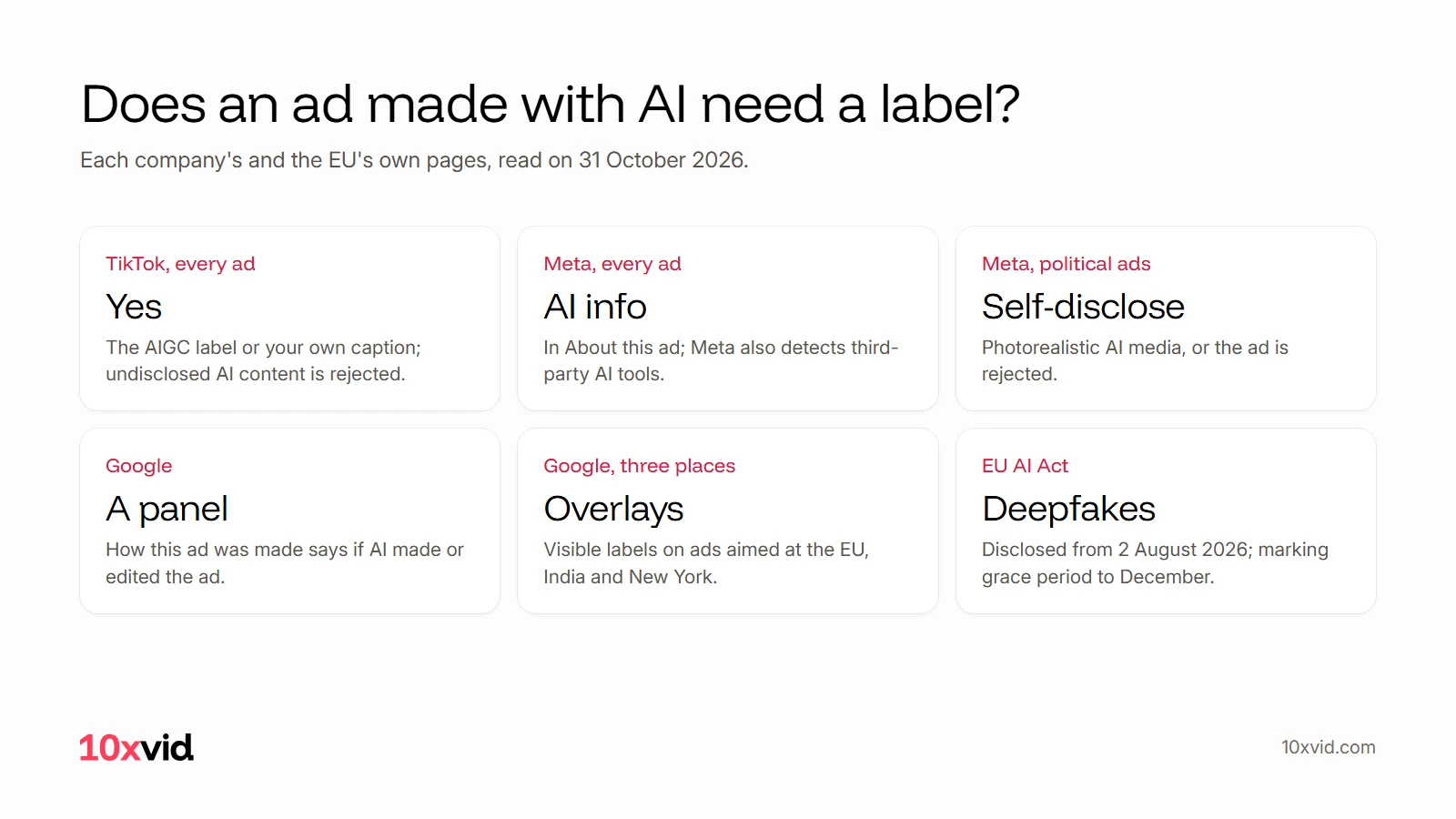
- TikTok: significantly edited media and AI-generated content are allowed with TikTok's AIGC label, or with "a clear disclaimer, caption, watermark, or sticker of your own." That covers "Content that contains images, video, or audio that are completely AI-generated" and AI voice cloning.2
- TikTok, the catch: "If we identify AI-generated content that has not been disclosed, your ad will be rejected or restricted."2
- Meta: "About this ad" will include "AI info" labels, and Meta "will also begin automatically detecting ads created or edited using third-party AI tools".4
- Google: a "How this ad was made" section across Search, YouTube and Discover "will indicate if an ad was created or edited with AI".5 On ads aimed at the European Union, India and New York, the label also shows on the ad.16
- Political ads: on Meta, an undisclosed photorealistic AI image, video or voice gets the ad rejected: "we will reject the ad". Google asks for the same disclosure in election ads.1718
- The EU: Article 50 of the AI Act requires deepfakes to be disclosed. "These transparency rules apply from 2 August 2026."3
TikTok's own survey found "60% want AI-generated content to be clearly labeled".19
Which AI apps cannot advertise?
Apps that make sexual images of real people, on every network and both stores:
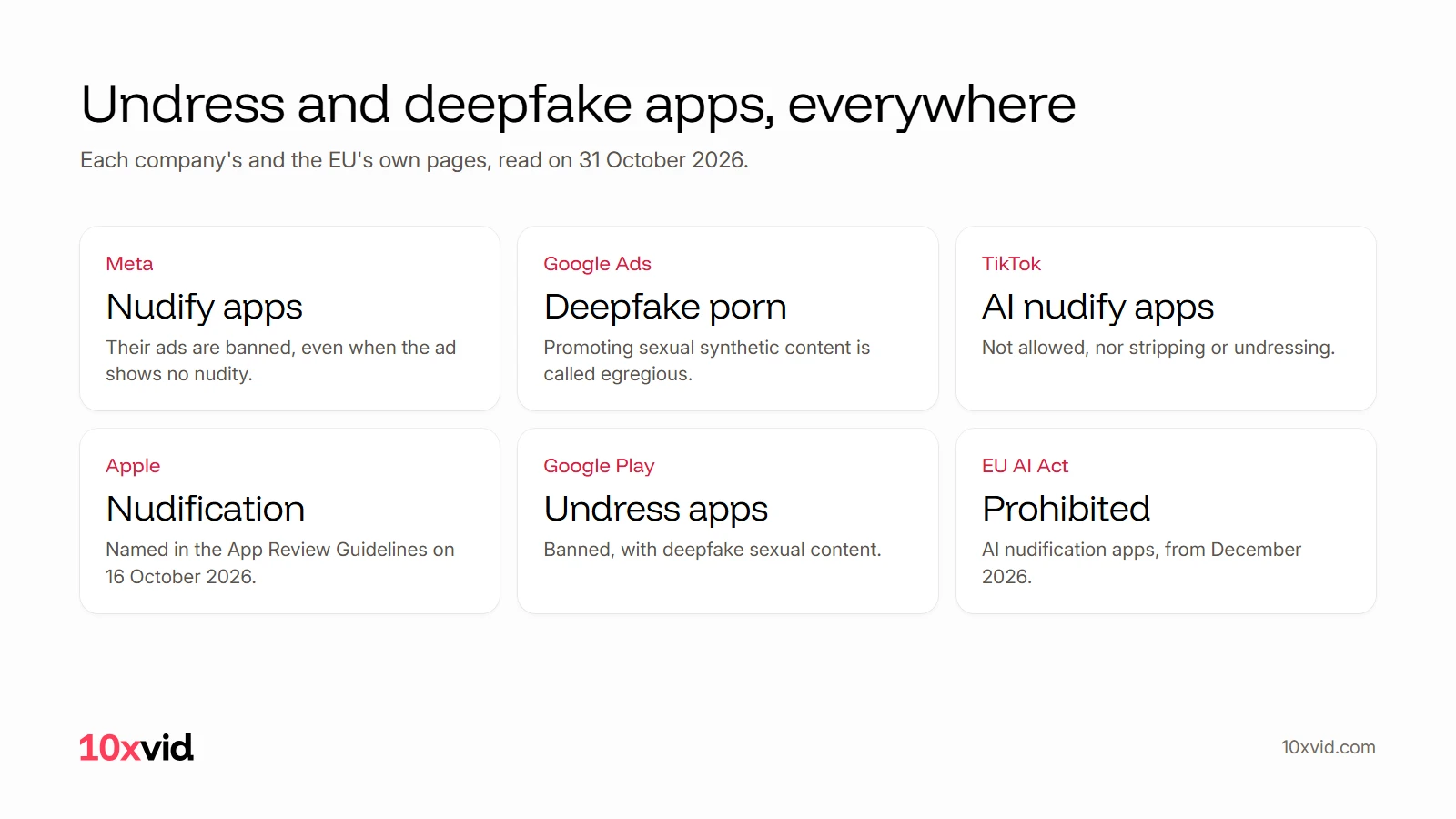
- Meta: "We have strict rules against non-consensual intimate imagery".6 It catches these ads "even when the ads themselves don't include nudity".6
- Google Ads: no "Content promoting the creation or distribution of synthetic content that has been altered or generated to be sexually explicit or contain nudity".7
- TikTok: not allowed: "Services that create content for sexual pleasure or sexual intention purposes, such as AI Nudify Apps". "Stripping or undressing" is not allowed in ads either.8
- Apple: its update of 16 October 2026 names nudification apps, which "create sexually explicit images of real individuals without their consent".20 Its guidelines now ask AI content apps for filtering, reporting and blocking.9
- The EU: a new ban covers AI nudification apps. "Prohibition 9 comes into effect in December 2026".21
Google Play bans "apps that claim to undress people or see through clothing", and deepfake sexual content.10
Can an AI app's ad use a famous face or voice?
Only with the person's consent. Google's example of what not to do: "Using AI-generated videos of popular YouTubers to mislead people into thinking they endorse a “Get rich quick” scheme".11 Its rule: "Make sure you have consent from any public figures and that you can prove it".11
- TikTok: no content "that uses or promotes the misuse of the likeness (audio or visual) of a public figure without their permission".2
- Snapchat: no "name, likeness (including look-alikes), voice (including sound-alikes)" without consent.22
- Google Play: no "Apps using public figures or media from a sensitive event to advertise media altering capability within an app's store listing."23
What do the app stores ask of an AI app?
Rules on data and on what the AI makes:
- Apple, data: "You must clearly disclose where personal data will be shared with third parties, including with third-party AI, and obtain explicit permission before doing so."9
- Apple, previews: "previews may only use video screen captures of the app itself."9
- Google Play: "Apps that generate content using AI must contain in-app user reporting or flagging features".24
- Google Play, features: no claims of impossible features, "even if labeled as a joke".23
What should an AI app video ad show?
One task, the real input and the real output. The apps' own stories point that way:
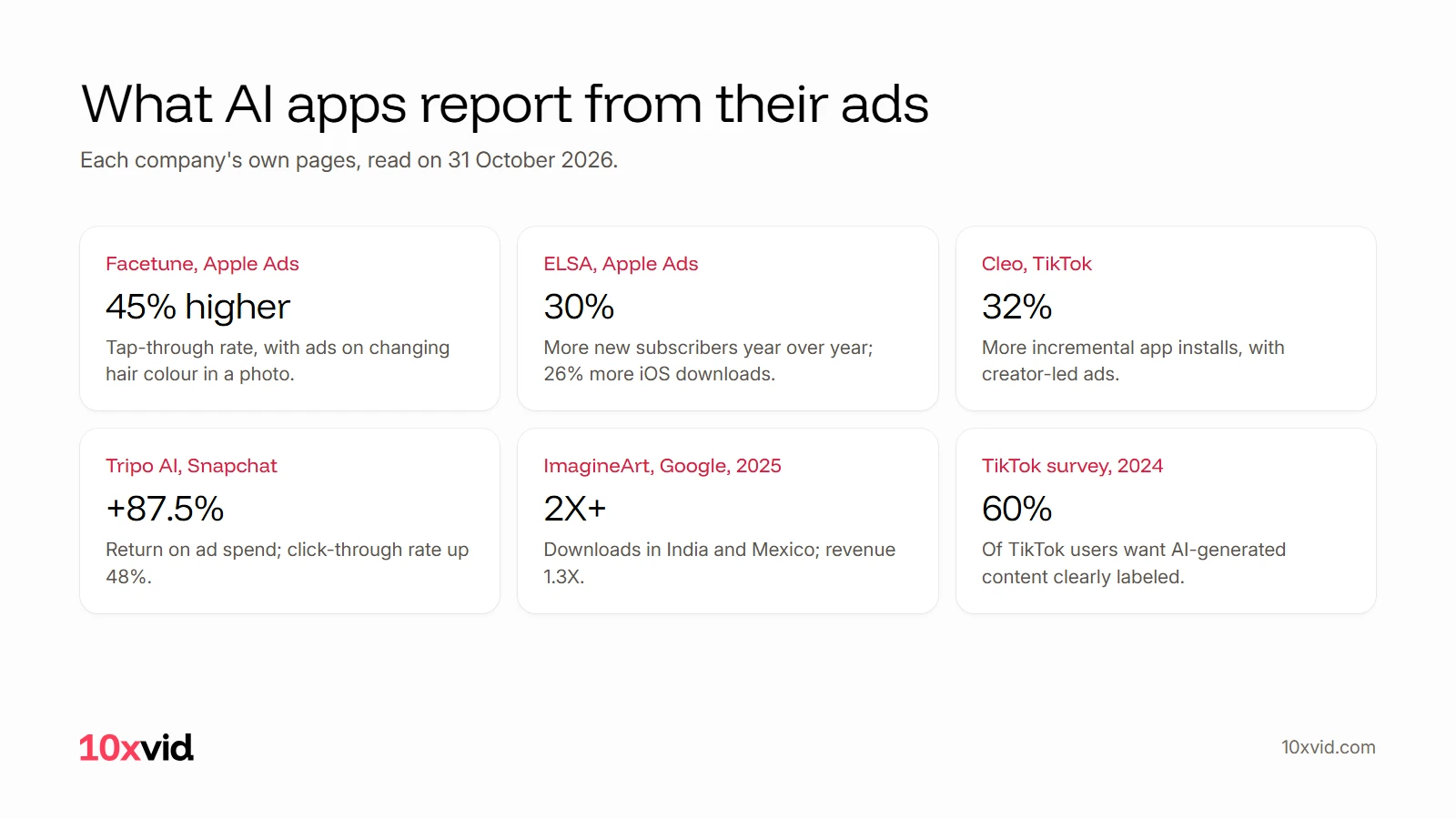
- One feature, named: Facetune's ads spotlighted "the ability to change hair color in a photo", matched to searches for a hair color changer. It reports a 45% higher tap-through rate than its default ad.25
- Real people talking: Cleo's TikTok ads "leaned heavily on creator-led content". It reports "a 32% increase in incremental app installs".26
- Results that last: ELSA reports 30% more new subscribers globally year over year, and 26% more iOS downloads.27
- One new product: Tripo AI reports "+87.50%" return on ad spend and "+48.15%" click-through rate on Snapchat.28
- Many versions: ImagineArt's maker "uses AI to generate new ad assets at scale, every other week", Its revenues grew 1.3X, and downloads "more than 2X in markets like India and Mexico".29
What puts people off, in TikTok's own research: "unrealistic AI-generated people, artificial voices, misleading product depictions and formulaic creative".30 So show the app on its real screens, and keep a demo's output one the app really made.
Where 10xvid fits
10xvid, motion graphics ads for apps, makes the video from your link, on your app's real screens. It runs 5 to 30 seconds, in 9:16, 1:1 and 16:9.31 Say in the chat which task the ad should show, and give it a real output from your app.
If you add a voiceover, it is a generated voice: label the ad where a network asks for AI-generated audio.2 10xvid does not check an ad against these policies for you.
Solo is about 30 video ads a month for $79, with the first month 50% off.32 Paste your link and make your first ad.
Questions about AI app marketing
Do I have to label an ad made with AI?
On TikTok, yes, when the ad has AI-generated media; an undisclosed one is rejected or restricted. Meta and Google label many ads themselves.245
Can my ad say the app is "AI-powered"?
Only if it is. The FTC asks whether the product "actually" uses AI. Using an AI tool to build a product is not the same as AI in it.1
Can an AI photo app show before-and-after images?
Carefully. TikTok bars before-and-after results that give "a false or distorted impression" of the outcome.2
When do the EU AI Act's labelling rules apply?
From 2 August 2026, with a grace period to December 2026 for marking content from AI systems already on the market.3
- FTC business blog, "Keep your AI claims in check" (ftc.gov/business-guidance/blog/2023/02/keep-your-ai-claims-check), 27 February 2023. ftc.gov refused our reader on 31 October 2026, so it was read in the Internet Archive's copy. ↩
- TikTok ads policy, misleading and false content (ads.tiktok.com/help/article/tiktok-ads-policy-misleading-and-false-content), last updated April 2026, read on 31 October 2026. ↩
- European Commission, quick facts on the AI transparency rules (digital-strategy.ec.europa.eu/en/factpages/quick-facts-transparency-rules-ai-systems), last updated 29 July 2026, read on 31 October 2026. ↩
- Meta Newsroom, "Gen AI transparency in Meta's ads products" (about.fb.com/news/2025/02/gen-ai-transparency-metas-ads-products), 3 February 2025, updated 1 June 2026, read on 31 October 2026. ↩
- Google blog, AI transparency labels in ads (blog.google/products/ads-commerce/google-ads-ai-transparency-labels), 9 July 2026, read on 31 October 2026. ↩
- Meta Newsroom, "Taking action against nudify apps" (about.fb.com/news/2025/06/taking-action-against-nudify-apps), June 2025, read on 31 October 2026. ↩
- Google Ads policy, sexually explicit content (support.google.com/adspolicy/answer/16490050), read on 31 October 2026. ↩
- TikTok ads policy, adult content (ads.tiktok.com/help/article/tiktok-ads-policy-adult-content), last updated August 2026, read on 31 October 2026. ↩
- Apple, "App Review Guidelines" (developer.apple.com/app-store/review/guidelines), last updated 16 October 2026, guidelines 1.2, 2.3.4 and 5.1.2, read on 31 October 2026. ↩
- Play Console Help, inappropriate content (support.google.com/googleplay/android-developer/answer/9878810), read on 31 October 2026. ↩
- Google Ads policy, unacceptable business practices (support.google.com/adspolicy/answer/15938071), read on 31 October 2026. ↩
- FTC press release on Workado (ftc.gov/news-events/news/press-releases/2025/04), 28 April 2025, read in the Internet Archive's copy. ↩
- FTC business blog, "Operation AI Comply" (ftc.gov/business-guidance/blog/2024/09/operation-ai-comply-continuing-crackdown-overpromises), 25 September 2024, read in the Internet Archive's copy. ↩
- Google Ads policy, unreliable claims (support.google.com/adspolicy/answer/15936857), read on 31 October 2026. ↩
- LinkedIn Marketing Solutions Help, the feedback option for low-value ads (linkedin.com/help/lms/answer/a16201003), read on 31 October 2026. ↩
- Google Ads Help, AI label settings (support.google.com/google-ads/answer/17140115), read on 31 October 2026. ↩
- Meta Transparency Center, social issue, election and political ads (transparency.meta.com/policies/ad-standards/SIEP-advertising/SIEP), read on 31 October 2026. ↩
- Google Ads policy, political content (support.google.com/adspolicy/answer/6014595), read on 31 October 2026. ↩
- TikTok for Business blog, generative AI perceptions study (ads.tiktok.com/business/en-US/blog/generative-ai-perceptions-study), 30 September 2024, read on 31 October 2026. ↩
- Apple Developer News, "Strengthening App Review Guidelines against nonconsensual intimate imagery and bait-and-switch apps" (developer.apple.com/news/?id=vvzx6cul), 16 October 2026, read on 31 October 2026. ↩
- European Commission, "AI Act" (digital-strategy.ec.europa.eu/en/policies/regulatory-framework-ai), last updated 19 October 2026, read on 31 October 2026. ↩
- Snap, advertising policies (snap.com/ad-policies), read on 31 October 2026. ↩
- Play Console Help, deceptive behavior (support.google.com/googleplay/android-developer/answer/17006354), read on 31 October 2026. ↩
- Play Console Help, AI-generated content (support.google.com/googleplay/android-developer/answer/13985936), read on 31 October 2026. ↩
- Apple Ads, Facetune success story (ads.apple.com/app-store/success-stories/facetune), undated, read on 31 October 2026. ↩
- TikTok for Business, Cleo case study (ads.tiktok.com/business/en-US/inspiration/cleo-smart-plus-case-study), undated, read on 31 October 2026. ↩
- Apple Ads, ELSA success story (ads.apple.com/app-store/success-stories/elsa), undated, read on 31 October 2026. ↩
- Snapchat for Business, Tripo success story (forbusiness.snapchat.com/success-stories/tripo), read on 31 October 2026. ↩
- Think with Google, Vyro AI (business.google.com/us/think/future-of-marketing/ai-app-roadmap-grow-profitably), October 2025, read on 31 October 2026. ↩
- TikTok, "AI Safety Essentials for Advertisers on TikTok" (ads.tiktok.com/business/library/AI_Safety_Essentials_for_Advertisers_on_TikTok.pdf), 2026, read on 31 October 2026. ↩
- 10xvid.com/engine, read on 31 October 2026. ↩
- 10xvid.com/pricing, read on 31 October 2026. ↩