How to make 8-bit pixel art videos for your app
To make an 8-bit video, draw your scene on a small grid of square pixels, about 270 by 480 for a phone. Animate it, scale it up four times with hard edges, add chiptune music and export an MP4.
 8-bit videos
In short
- An 8-bit video is pixel art that moves: a low grid, few colours, dark outlines, a pixel font and chiptune music.
- The pixel reels that travel furthest share one plan: the viewer plays along, one world, one number, faces, one thing at a time, and a loop.
- You can draw one by hand in a pixel editor, or ask 10xvid's 8-bit skill, which draws it in code from a sentence.
What is an 8-bit video?
An 8-bit video is pixel art that moves, drawn to look like the games of the 1980s. The name comes from that era's consoles, and their limits made the look. Nintendo's NES picked from 64 colours and gave backgrounds and sprites "4 palettes of 4 colors" each, with sprites of "8x8 or 8x16 pixels".1
Today the look matters more than the limits. The fantasy console PICO-8 keeps a "128x128, fixed 16 colour palette" on purpose.2 A pixel art film you post today has:
- A low grid. Every shape sits on square pixels far bigger than the screen's own, with hard steps at its edges.
- Ramps instead of gradients. Each colour comes in three or four tones, with a checker of two tones between them. That checker is ordered dithering, a fixed pattern "tiled across an image".3
- Dark outlines and a pixel font. Both keep shapes and words readable at a small size.
- Chiptune music. It is music "made using the programmable sound generator (PSG) sound chips" of old consoles and computers.4
One note on the words: "8-bit video" also names a file setting, 8 bits of colour a channel. This guide is about the look.
Why do pixel art reels get watched?
They reach people who do not follow you yet. One account of pixel science reels started on 13 October 2026. Its site says it had 29 million views in its first three weeks, and "89% of views came from people who don't follow us yet".5
We studied that account's six pinned reels and eight of its films on 9 November 2026. The pinned reels showed 1.1 to 4.3 million views each that day. The films ran 32 to 52 seconds, vertical, at 60 frames a second, with no voice at all.6 All of them did the same seven things:
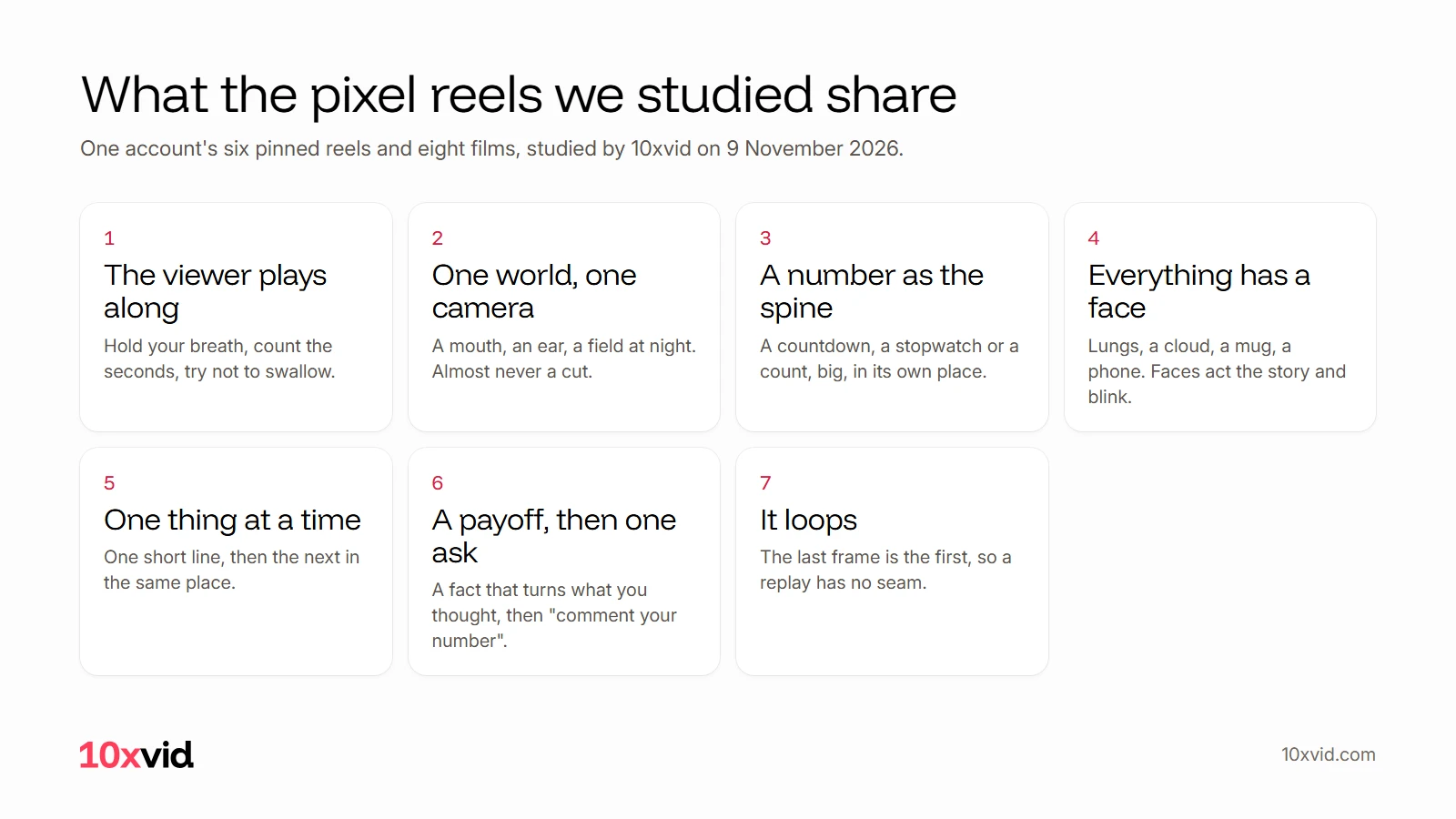
- The viewer does something while it plays. Hold your breath, count the seconds after the flash, try not to swallow. That is watch time, and comments.
- One world, one camera. A mouth, an ear, a field at night. The camera glides through it and almost never cuts.
- A number as the spine. A timer, a stopwatch or a count, big, in a place of its own.
- Everything has a face. Lungs, a cloud, a mug, a phone. The faces act the story and blink.
- One thing at a time. One short line, then the next in the same place, the key word in gold.
- A payoff, then one ask. A fact that turns what you thought, then one ask: comment your number, or send it to a friend.
- It loops. The last frame is the first, so a replay has no seam.
How do you plan an 8-bit video before you draw it?
Write it on one page first, because a pixel film is slow to change once drawn. The page holds five things:
- The hook: what the viewer does in the first second, in words a stranger understands.
- The world: the one place the film happens, and the camera's path through it.
- The number: the one true number that runs the film, and where it comes from.
- The cast: who has a face, and what each one feels at each moment.
- The end: the payoff, the one ask, and the way back to the first frame.
For a product, the problem becomes the world, and the product does its one job in it. Show its screen as pixel art too, on a pixel phone or drawn into the world. A smooth screenshot pasted on a pixel world looks like a sticker.
How do you make an 8-bit video by hand?
You need a pixel editor such as Aseprite or Piskel, a video editor and a music track. Then:
- Set the grid. Draw at 270 by 480 pixels for a 9:16 phone film; four screen pixels a pixel makes 1080 by 1920. Use 270 by 270 for a square film.7 Start in the final shape, because cropping later breaks the grid.
- Build the palette from your brand. Give each brand colour three or four tones, darker to lighter. Put a dithered checker between tones instead of a smooth gradient.
- Draw the cast. A body, two eyes and a mouth are enough. Give each character a few moods and a blink. A hero's eye of about six grid pixels reads on a phone.7
- Animate in steps. The hand guides set sprite animation at 8 or 12 frames a second,8 12,9 or 15.10 A camera glide can run smoother, at 30 or 60, if every frame is drawn on the grid again.
- Set the words. Use one pixel font, white with a dark outline, the key word in one colour. Write three to seven words a line. Hold each line about 0.4 seconds a word, plus 0.6.7
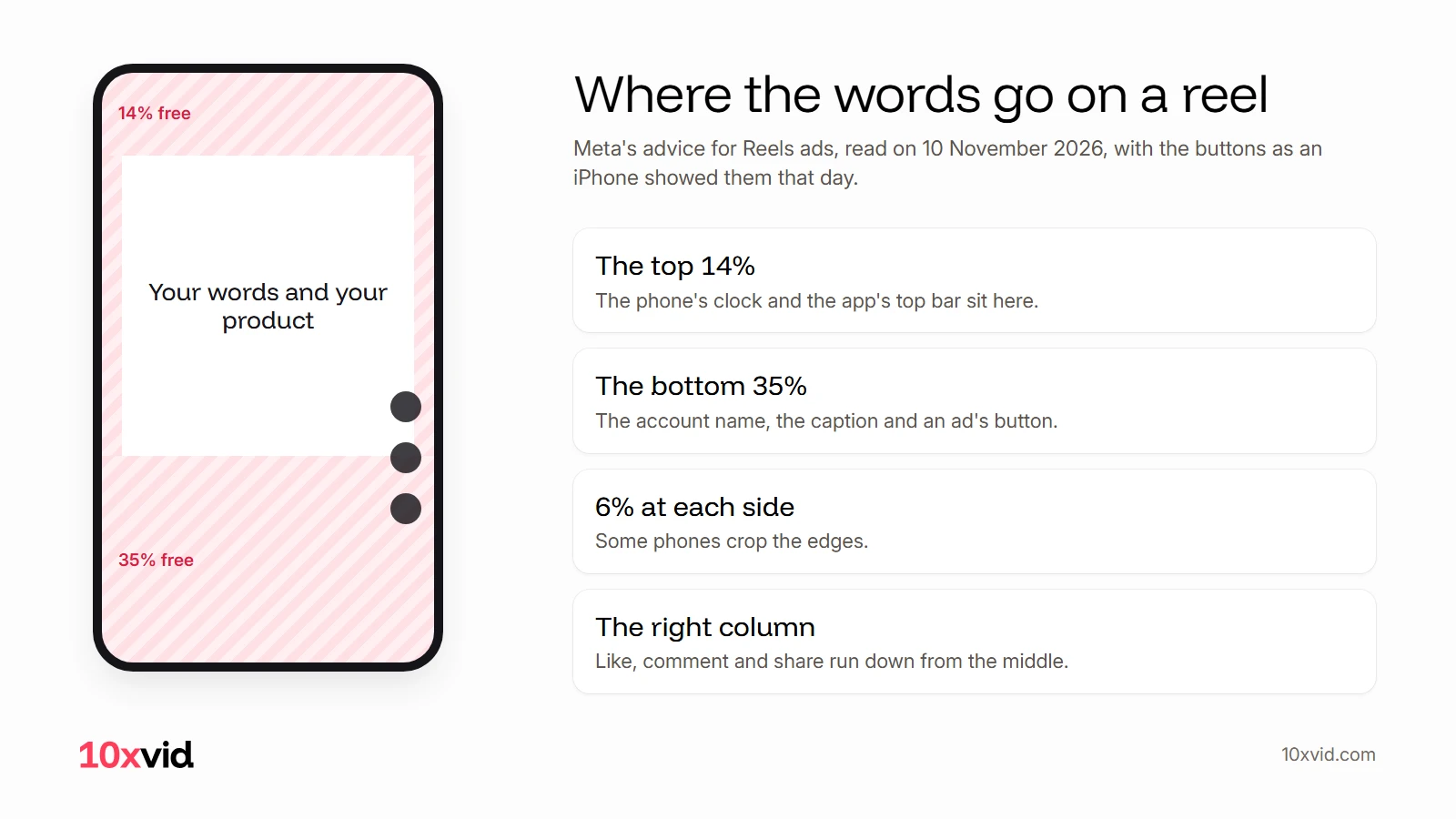
- Keep clear of the app's buttons. Meta's advice for Reels ads is to leave "at least 14% of the top, 35% of the bottom, and 6% on each side" free of text and logos.11
- Add the sound. Use chiptune under the whole film and a sound on each hit. The reels we studied leave a moment of silence before each big hit.6
- Scale up and export. Scale by a whole number with nearest neighbour, never smoothing, so each pixel stays square. Export an MP4 whose last frame matches its first.
Can an AI video generator make an 8-bit video?
It can make a clip that looks like pixel art, and it can't hold the grid. A video model paints pixels, not squares on a grid. Edges soften, the squares change size from frame to frame, and a character's face drifts between clips. FluxNote's own guide warns of "the 'boiling' effect, where static parts of the image shimmer unnaturally".12
A pixelate filter over footage has the opposite problem. You get blocks, but no outlines, no faces and no font that reads. Drawing the film in code keeps every pixel square at any zoom, and the same character in every film.
How do you make an 8-bit video in 10xvid?
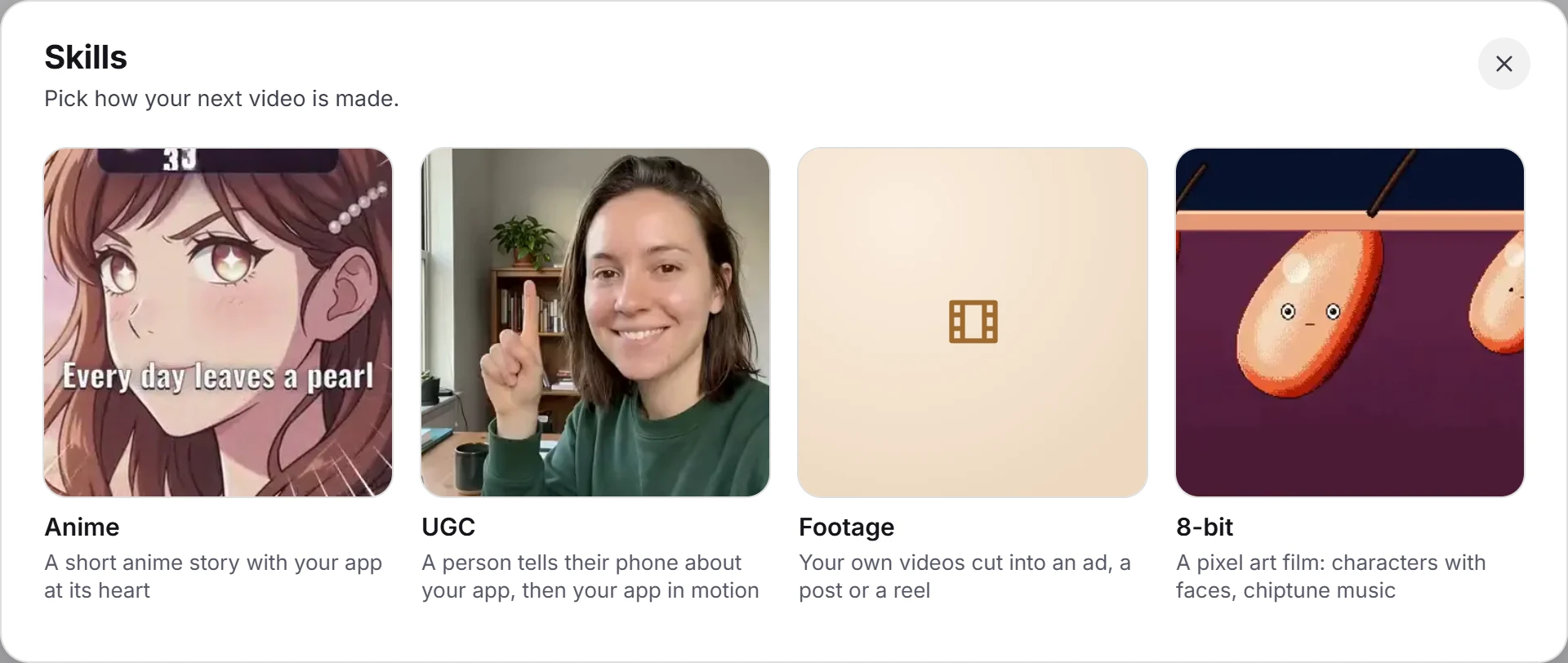
Open Skills and pick 8-bit, or write "8-bit" in the chat. Then say what the film is about. A link to your product is optional: the skill makes a product demo, an explainer or your own idea.7
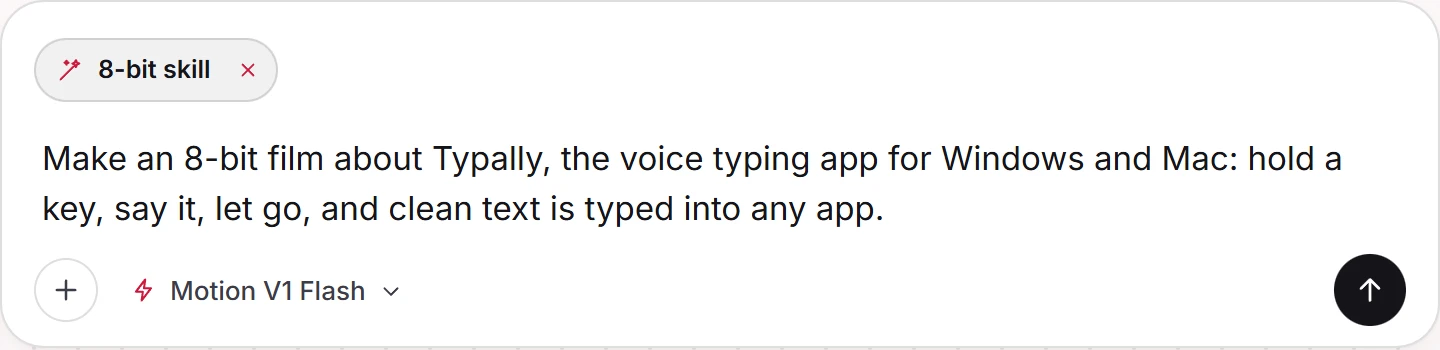
We made three films this way on 10 November, for our own apps. The Typally film at the top took 21 minutes from the request to the finished film.13 Its hook asks you to guess how many words 100 minutes of talking makes. A keyboard and a microphone swat the "um" out of a Slack message. Then a count climbs from 150 words to 15,000, one step at a time. Every number is on Typally's own page.14
The Perla film took 11 and a half minutes. A pearl counts down from 10 while it asks about your dream morning, then shows Perla's real screen on a pixel phone. We would redo its background: the big pale shapes look smudged next to the crisp pearl.
The film is drawn in code on a true pixel grid: 270 by 480 for a 1080 by 1920 film. Its characters have 25 moods and blink on their own. Before you see it, the skill's own check reads the film. It flags things that arrive together, words under the app's buttons, a count that skips a step and a zoom too fast to follow.7
The next 8-bit film of the same project keeps its characters and look, so a series stays one series.
It can also copy a reel. Paste the reel's link with 8-bit picked, and the film keeps its story, beats and timing in pixel art.7 We copied one of our own ads, Word by word, from its link in 19 minutes.13 Each beat lands on the same second, told by a play button and a phone with faces.
What mistakes make an 8-bit video hard to watch?
- Too much at once. Our own first 8-bit film for Typally, on 9 November, had a race, a monitor and labels arriving together. Nobody knew where to look. We rebuilt the skill that night around one new thing at a time.
- Words that move. When each line lands in a new place, the eye hunts. Keep the reading line at one height.
- A count that skips steps. Show the first split, then two, four, eight, a beat each, before it runs. A fast zoom loses people.
- Words too small, or under the clock and the buttons. Read the film on a phone, inside Instagram, before you post.
- Smooth scaling. A blurred pixel is not a pixel. Scale with nearest neighbour.
- A face that changes. A character that looks different in each film breaks a series.
Where 10xvid fits
10xvid, motion graphics ads for apps, makes the 8-bit film from a sentence or a link, with your screens and logo drawn as pixel art. It writes the story first, draws the cast and the world in code, writes the music, checks the film and renders it. You decide what the film says, and you can ask for a new version in the chat.
Paste your link and make your first ad.
Questions about 8-bit videos
How long should an 8-bit video be?
The reels we studied ran 32 to 52 seconds.6 10xvid's 8-bit films run about 30 seconds unless you ask for 15 to 60. Instagram recommends videos "3 minutes or less" for people who don't follow you.15
Can I copy a reel in 8-bit?
Yes. Paste the reel's link with 8-bit picked. The film keeps its story, beats and timing, drawn in its own pixel art, as long as the reel.7
Can my real app screen be in it?
Yes, as pixel art. The film draws your screen and your logo on its own pixel grid, in their own colours, so they belong to its world.7
Does it need a product?
No. An explainer or an idea works with no link, and the company's name can sit small at the end or not at all.7
Where does the music come from?
It is chiptune written new for each film, with no voice, at 120 beats a minute, and the picture moves on its beats. Where the subject has a rhythm of its own, like a heartbeat or an engine, the drums play it.7
- NESdev Wiki, PPU palettes (nesdev.org/wiki/PPU_palettes), last edited 13 September 2026, read on 10 November 2026. ↩
- PICO-8 manual, v0.2.7 (lexaloffle.com/dl/docs/pico-8_manual.html), read on 10 November 2026. ↩
- Wikipedia, Ordered dithering (en.wikipedia.org/wiki/Ordered_dithering), read on 10 November 2026. ↩
- Wikipedia, Chiptune (en.wikipedia.org/wiki/Chiptune), read on 10 November 2026. ↩
- sciencein8bit.com, read on 10 November 2026. Its counts are its own, "counted on Instagram on 4 November 2026". ↩
- 10xvid's study of the account's six pinned reels and eight films its site hosts, 9 November 2026; views as Instagram showed them that day. ↩
- 10xvid app (10xvid.com/app) and the 8-bit skill's brief and kit, 10 November 2026; the API reference for videos (10xvid.com/docs/api/reference/videos). ↩
- FluxNote, How to make pixel art animation with AI (fluxnote.io/guides/how-to-make-pixel-art-animation-with-ai), read on 10 November 2026. ↩
- Prolific Studio, How to make a pixel art animation (prolificstudio.co/blog/how-to-make-pixel-art-animation), read on 10 November 2026. ↩
- ProductionCrate, How to make an 8-bit effect (news.productioncrate.com/8-bit-in-after-effects), read on 10 November 2026. ↩
- Meta Ads Guide, Instagram Reels video (facebook.com/business/ads-guide/update/video/instagram-reels), read on 10 November 2026. ↩
- FluxNote, How to make pixel art animation with AI (fluxnote.io/guides/how-to-make-pixel-art-animation-with-ai), read on 10 November 2026. ↩
- Our three films, asked for through 10xvid's API on 10 November 2026; the time is from the request to the finished film. ↩
- typally.com, read on 10 November 2026: "All 308 apps", "People speak about 150 words a minute", and 100 minutes a month free, no card. ↩
- Instagram, creators FAQ (creators.instagram.com/faq), read on 10 November 2026. ↩